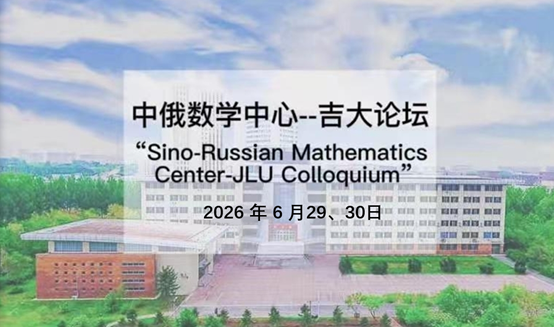
报告题目:Shuffle Algebras and Lie-Theoretic Structures in Free Probability
报告人:Kurusch Ebrahimi-Fard
所在单位:Norwegian University of Science and Technology
报告时间:9:00-10:00, 14:00-15:00 June 29, June 30, 2026
报告地点:娱乐城
正新楼106
报告摘要:
This series of introductory lectures presents algebraic and combinatorial structures underlying free probability theory, with particular emphasis on shuffle algebras, pre- and post-Lie structures, and their role in moment-cumulant as well as cumulant-cumulant relations, Wick polynomials, and operator-valued free probability.
Free Probability: The first lecture introduces the basic framework of noncommutative probability, focusing on free, Boolean, and monotone independence. We discuss the notion of cumulants and the corresponding moment-cumulant and cumulant-cumulant relations through the lens of noncrossing partitions and related combinatorial structures. Particular attention is paid to Wick polynomials and their role in organising moment-cumulant relations.
Shuffle Algebra: The second lecture develops the algebraic background of shuffle and unshuffle bialgebras together with associated pre-Lie and post-Lie structures. We explain how these structures naturally arise from combinatorial Hopf algebras and from algebraic approaches to differential equations and Magnus-type expansions.
Shuffle Algebras in Free Probability: In the third lecture, we explain how shuffle algebra methods provide a unified framework for cumulants and Wick calculus in free probability. Half-shuffle exponentials and logarithms lead naturally to (Lie-)algebraic descriptions of free, Boolean, and monotone cumulants as well as recursive constructions of Wick products.
Operator-Valued Free Probability: The final lecture turns to operator-valued free probability and recent developments involving post-Lie algebras. We explain how post-Lie structures naturally encode noncommutative and operator-valued aspects of cumulant theory and discuss connections with Magnus expansions, noncommutative stochastic analysis, and applications to quantum probability.
The lectures aim to highlight the interplay between combinatorics, Hopf algebras, and Lie theory in modern free probability.
报告人简介:
Kurusch Ebrahimi-Fard was born in Cologne, Germany, and received his Ph.D. in Theoretical Physics from the University of Bonn under the supervision of D. Kreimer and R. Flume. He has held postdoctoral positions at several institutions, including the IHES (Bures-sur-Yvette), the Max Planck Institute for Mathematics in Bonn, the Universidad de Zaragoza, and the ICMAT in Madrid. During his time in Spain, he was awarded both the Juan de la Cierva and Ramón y Cajal fellowships. He has also been a fellow of the Studienstiftung des Deutschen Volkes, the Evangelisches Studienwerk, the German Academic Exchange Service (DAAD), and the European Post-Doctoral Institute. He is currently Professor of Mathematics at the Department of Mathematical Sciences, NTNU, Trondheim, Norway, and an elected member of the Royal Norwegian Society of Sciences and Letters (DKNVS).
His research lies at the interface of algebra and combinatorics, with a dual emphasis on theory and applications. Central topics include Magnus-type expansions, combinatorial Hopf algebras, shuffle-type bialgebras, Rota–Baxter algebras, pre- and post-Lie algebras and groups, (Lie–)Butcher series, signature methods, Chen–Fliess series, combinatorial Dyson–Schwinger equations, non-crossing partitions, and operads. A unifying theme of his work is the development of algebraic and combinatorial structures as tools for modeling and analyzing phenomena across a range of areas, including Lie group methods for differential equations, stochastic calculus, free probability theory, control theory, rough paths, quantum machine learning, Hairer's regularity structures, renormalization in perturbative quantum field theory, and multiple zeta values.